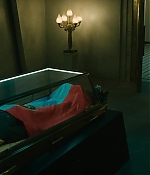
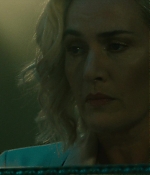
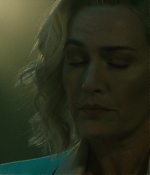
Last night, the five-part mini series, Mildred Pierce came to quite a disastrous end. In parts four and five, nine years have passed and Mildred Pierce (Kate Winslet) continues to break her back for her ungrateful daughter, Veda Pierce (Evan Rachel Wood) even after a heated argument leads to Mildred kicking Veda out of the house. As fulfilling as it was to watch Veda being thrown out after ripping her mother to shreds yet again, that satisfaction only lasted for a moment. Mildred’s constant need to keep her adult daughter happy consumes her life until it can’t anymore.
With all of the cooking showcased in parts one through three, the early years resembled visuals similar to Julie & Julia. Though parts four and five focused more on the dramatic elements that viewers were anticipating from the very beginning. It was so odd and in a way unsettling to watch Kate Winslet in a role that pushes her to be so inferior. For a woman managing her own restaurant and bakery, Mildred sure lacks leadership strengths with her own flesh and blood.“What are you insinuating, that my daughter is a snake?”
“It’s much worse.”As for Evan Rachel Wood, there were glimpses in past roles that she has played of a selfish little girl. Wood was able to let it all out as Veda, the lying, stealing, and manipulative young woman with nothing going for outside of her opera career. Wood was much more dramatic than some viewers may have anticipated, but it definitely works for this character. As the man whom Mildred ran into said, Veda is a wonderful singer but not a wonderful girl. Wood plays the part perfectly. Clearly, Veda is not just an ungrateful daughter but the world’s most awful human being. Her inability to be a good person proves to be the cause for her inability to be a success outside of her singing career. By the way, if you want to hear Evan Rachel Wood singing some more, pick up the Across The Universe soundtrack. Also, 1940s wardrobe definitely agrees with Wood.
Continue reading “Mildred Pierce” miniseries review: Parts Four & Five

 Painstakingly constructed settings are usually reserved for epic science fiction fantasies where directors have unparalleled freedom to create digital environments, but there are no superheroes in a Todd Haynes film — just empathetic, flawed human beings acting out their lives in minute period detail. Haynes became a cult icon when his 43-minute short film Superstar (1987), the tragic saga of anorexic pop star Karen Carpenter told using Barbie dolls, was banned from circulation because of copyright issues. (Bootleg copies can still be viewed on YouTube.) Haynes, who was born in Los Angeles in 1961, has been tweaking societal conventions ever since. As a pivotal member of the New Queer Cinema movement, he enraged conservative politicians with frank depictions of gay sex in Poison (1991), then upended his own audience’s expectations four years later, with the jarring hypochondriac drama Safe (1995). Subsequent films such as Velvet Goldmine (1998), Far From Heaven (2002), and I’m Not There (2007) manage to embrace both experimental and formal aims, like academic theses wrapped in sweeping, melodramatic arcs. Throughout his career, the director has explored how women have navigated visible and invisible levers of power. “I’m drawn to female characters,” he tells Kate Winslet, his self-professed “other Coen brother” and star and co-producer of his new HBO miniseries, Mildred Pierce. “And not all of them are strong characters.” Airing this spring, the five-part miniseries tells the story based on the novel by James M. Cain, of a resilient but imperfect woman who struggles to raise a family in Great Depression–era Los Angeles. Winslet recently spoke with Haynes, who was at his home in Portland, Oregon, about, among other things, Mildred Pierce, why he’s never made a film set in the contemporary world, and the challenge of letting things go.